


Your documents and tools, a question away
Find a procedure, understand a customer’s history or prepare a report. A business assistant helps your team work from company information within its access permissions.
- Expertise
- Product & software
- Audience
- Your team
- Uses
- Search · summarise · prepare
- Context
- Documents · cases · business tools
- Access
- Defined roles and approved sources
The project in practice
- Who it is for
- Teams regularly searching documents or preparing replies, summaries and reports from cases.
- What is delivered
- An assistant on the agreed scope, sources and permissions, verification cases and handover.
- Budget and conditions
Quoted according to documents, users, tools and functions. Data preparation and operation are explained.
- What the quote defines
- Functions, access, sources and update rules are specified. Actions and approvals are scoped when included.
The questions that interrupt the day
Where is the right procedure?
The assistant finds relevant passages in authorised documents and links to sources. The team can check the version and context before applying an instruction.
What has happened on this case?
A summary brings together available exchanges, progress and documents so someone can pick up the case without rereading every file.
How should I prepare this reply?
A draft uses the case information and your writing rules. The team member checks the facts, adjusts the tone and decides whether to send it.
Can these notes become a report?
Notes or supplied text become a draft using your structure: observations, decisions and next actions. Missing details remain identifiable.
Build around a team’s actual use
- 1
Choose a task and its users
We select a recurring question or document. The people involved provide examples of useful answers and errors to avoid.
- 2
Prepare sources and access
Documents are selected and updates organised. Access follows the agreed roles: people must not discover cases they are not allowed to read.
- 3
Evaluate real cases
We check source fidelity, incomplete answers, out-of-scope questions and readability. Corrections become verification cases.
- 4
Integrate it into daily work
The assistant takes a suitable form: a dedicated space or a function in your business software. Handover, content updates and support are defined with the team.
Experience built with Stellary
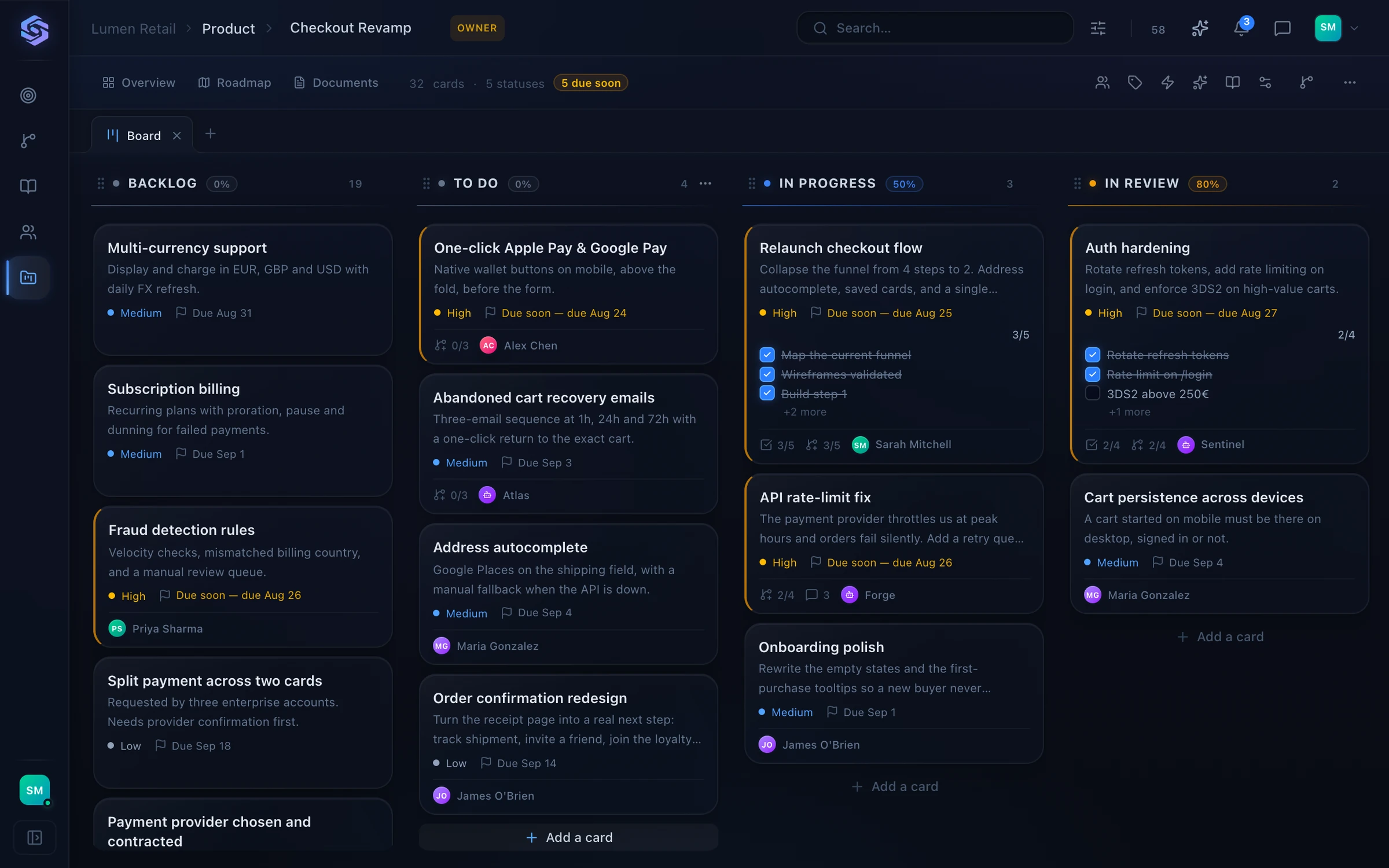 Stellary · See the case study
Stellary is Anym’s own product for organising projects, context and work performed by AI agents. It brings together questions a team assistant must answer: what context to read, who can act and how work is tracked.
That experience informs the design of your tool. Stellary is our own product; your assistant is scoped around your activity, data and users.
An assistant with a known scope
- The approved sources, their owners and update rules.
- Roles, access permissions and available functions.
- Verifiable answers and a clear indication when information is missing.
- Real verification cases, handover and support conditions.
- Separate implementation, hosting and model-usage costs.
See the work behind this expertise
Current studio projects showing product, design and development decisions.
What we get asked most
The answers we give anyway at the first conversation.
How is it different from a website chatbot?
A customer chatbot serves visitors with information you want to share publicly. A business assistant serves the team using internal sources and role-based access.
Our documents are scattered. Can we start?
Yes, by selecting a small useful set with clear ownership. Sorting, versions and permissions are part of preparation. The assessment identifies that work before implementation.
Can it take action in our software?
Some actions can be added with explicit permissions. When the need involves several steps and decisions, we scope a connected agent with approval points.
How do we keep control of costs?
The quote separates development and operation. Users, frequency, models and documents help estimate running costs and define useful limits and monitoring.
What often comes with it
Apps, business tools, and infrastructure: what keeps an activity running every day.
- Product & softwareBusiness AI assessmentFind useful opportunities for AI and automation in your business. Anym reviews your tasks and tools, then defines a first project and the costs to consider.
- Product & softwareCustomer chatbotsA chatbot grounded in your information to answer questions, guide visitors and prepare enquiries. Designed for your website, with a clear handover to your team.
- Product & softwareConnected AI agentsAI agents for defined business tasks: context, connected tools, approvals and progress tracking. Custom design and integration by Anym.
- Product & softwareCustom softwareCustom software development: management tools, back-offices, and internal business apps, built on your real processes rather than a package.




Which question keeps interrupting your team?
A procedure to find or a case to prepare can be enough to define a first use.
Find out what I could automate Reply on business days · contact@anym.fr