

SaaS development and product creation
Building a SaaS is not an app with a pricing page. It is a product that must isolate its customers, collect payment every month, be administered, and stay up while you sleep. Those four points decide, not the homepage.
- Expertise
- Product & software
- Nature
- Multi-tenant product sold on subscription
- Scope
- Product · architecture · billing · operations
- Stack
- TypeScript · PostgreSQL · documented API
- Proof
- Stellary, our own SaaS in production
What a SaaS demands beyond an application
Software accessed online, usually offered as a subscription. development differs on one point: an application serves one client, a SaaS serves hundreds, on the same codebase, without anyone seeing another's data. That constraint runs through the whole product: the data model, queries, backups, logs, exports. It is decided on day one and is very hard to retrofit.
Then comes the money. Trials, prorated plan changes, failed charges, dunning, refunds, VAT by customer country: subscription billing is a domain of its own, not a payment button.
Then operations. A Software accessed online, usually offered as a subscription. updates for everyone at once, without downtime, with database migrations that must run on real data. That is what distinguishes a product from business software deployed for a single client.
What to build, and in this order
Order matters: each of these bricks costs far more to add later than to set at the start.
- 01
Isolation
An organisation, its members, its data. Isolation lives in the model and is verified by tests: a query that forgets the tenant filter is the most ordinary and the most serious Software accessed online, usually offered as a subscription. flaw.
- 02
Subscriptions
Plans, trials, proration, mid-cycle changes, failed payments, dunning, refunds. The payment provider collects; it is your product that must know what each customer is allowed to do at every moment.
- 03
Roles
Owner, admin, member, guest. Explicit permissions rather than a pile of conditions in the screens — that is what lets you add a role later without rereading everything.
- 04
Arrival
Sign-up, space creation, inviting the team, a first useful result. Software accessed online, usually offered as a subscription. drop-off is decided in the first minutes, long before the trial ends.
- 05
Administration
See accounts, help a customer, extend a trial, refund, read the logs. Without this tool, every support request becomes a SQL query written by hand in production.
- 06
Observability
Errors surfaced, usage metrics, alerts on what deserves a wake-up. A product customers pay for cannot wait for a user to report the outage.
From the first user to a product that holds
- 01
Scope what you sell
Which problem justifies a recurring subscription, for whom, and at what price. A Software accessed online, usually offered as a subscription. without a clear answer to those questions becomes custom software in disguise, with product costs and service revenue.
- 02
Build the core, not the catalogue
A first version that does one thing fully, with isolation and billing in place. A half multi-tenant product is rewritten; a product with one feature extends.
- 03
Confront real customers
The first users reveal what no specification had planned — often a starting assumption about their internal organisation. Better to discover it on a handful of accounts than at scale.
- 04
Industrialise
Zero-downtime deploys, replayable migrations, backups restored for real, monitoring and on-call. This is when the product stops depending on the person who wrote it.
What you receive
- A multi-tenant product whose isolation is tested, not only claimed.
- The full subscription chain: plans, trials, proration, failed payments, invoices.
- An admin that lets you help a customer without touching the database.
- Automated deployment, replayable migrations, and verified backups.
- The code, the database, and the documentation: the product is yours, including if you change vendor.
We operate our own SaaS
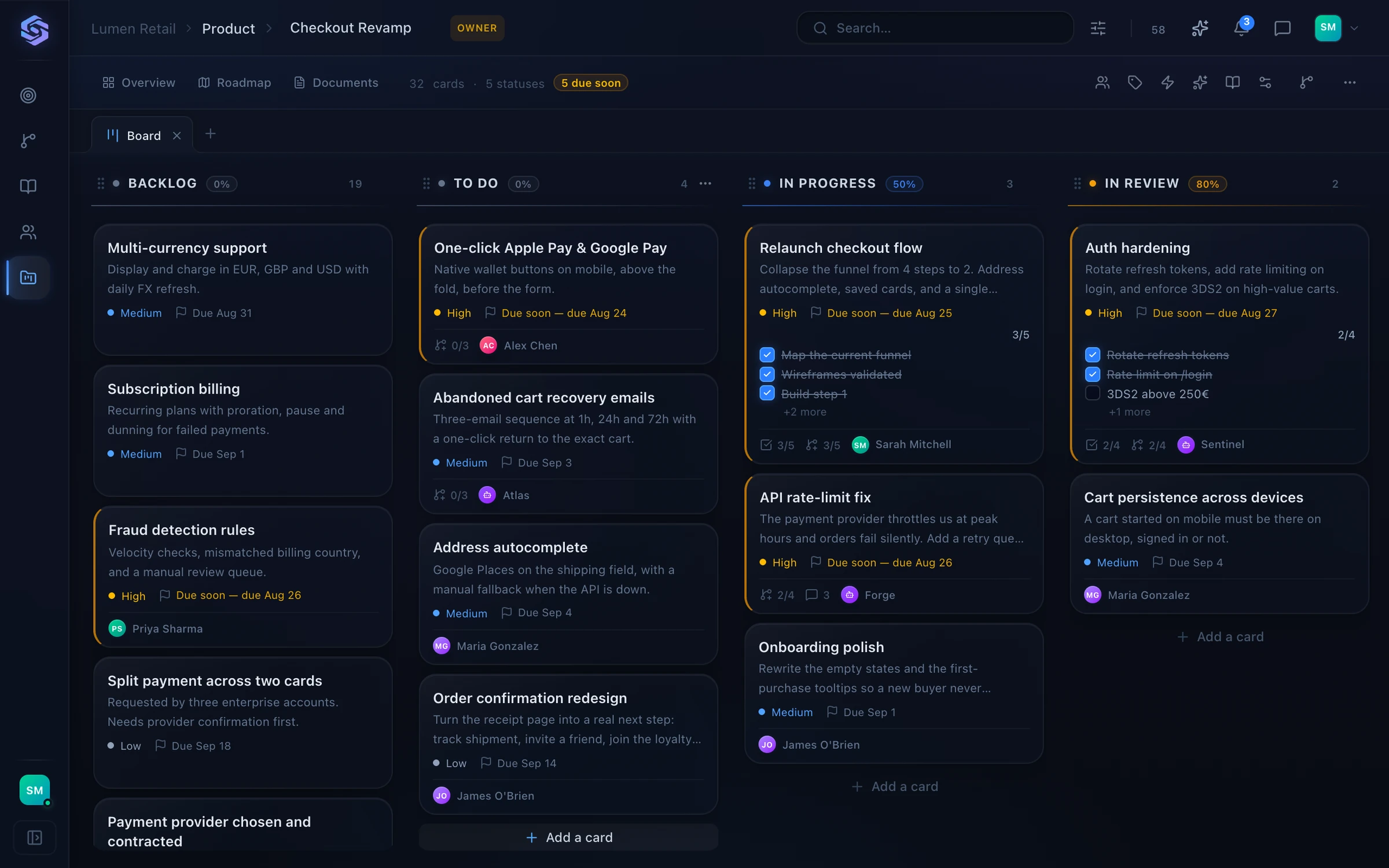 Stellary · See the case study
The studio does not only sell Software accessed online, usually offered as a subscription. development: it runs some. Stellary is a multi-tenant platform with organisations, workspaces, permissions, billing, administration, and monitoring — built, deployed, and maintained here.
That changes two things on a brief. First the trade-offs: we have already paid for the bad ones, on our own products. Then honesty on timelines — when you operate what you sell, you know what the second year actually costs.
The same foundation serves clients: Créarègle carries recurring payment, distinct roles, and infrastructure that is backed up and monitored.
See the work behind this expertise
Current studio projects showing product, design and development decisions.
What we get asked most
The answers we give anyway at the first conversation.
What does it cost to build a SaaS?
A first sellable version — isolation, subscriptions, and one finished feature — generally sits beyond a classic business app, because billing and isolation are incompressible work. The budget is scoped after a first conversation about what you sell and to whom.
Should you start with an MVP?
Yes, provided "minimum" applies to the feature set and never to the foundations. A product with one feature and correct isolation extends; a rich product that is poorly isolated is rewritten.
One database per customer, or a shared one?
A shared database with strict isolation covers most cases and costs far less to operate. A database per customer is justified by regulatory demands or very large customers — it is an architecture decision, not a preference.
Who handles payments and VAT?
The payment provider collects and handles VAT by customer country. Your product must know, at every moment, the subscription state and the rights that follow — that is the part we build.
What if we bring the team in-house later?
That is planned from the start: versioned and delivered code, a standard database, a documented A connection that allows two pieces of software to communicate., automated deployment, and written procedures. A product you cannot hand over is a product that holds you hostage.
What often comes with it
Apps, business tools, and infrastructure: what keeps an activity running every day.
- Product & softwareWeb applicationsCustom web applications: complex journeys, real time, roles, and data. Reached from a browser, with no install and no store.
- Product & softwareCustom softwareCustom software development: management tools, back-offices, and internal business apps, built on your real processes rather than a package.
- Product & softwareInfrastructure & securityDeployment, hosting, CI/CD, authentication, backups, and observability. Put a product in production and keep it safe without slowing its evolution.
- Product & softwareCustom CRMCustom CRM development: clients, quotes, invoices, projects, calendar, and accounting in one tool, built around how you actually work.


A SaaS to launch?
Tell us what you sell and to whom. We will scope the first version.
Start a project Reply on business days · contact@anym.fr