


AI solutions: models wired into your real tools
Our craft does not change with AI: understand yours, then remove what wastes time — re-entry, repeated tasks, flows that jam. Models are one more lever, provided they are wired to your tools, your data, and your rules.
- Expertise
- Product & software
- Use cases
- Business assistants · automation · document search
- Models
- Claude · GPT · open models, as needed
- Data
- Europe hosting · GDPR · isolation
- Control
- Explicit rules · human validation · measured cost
The project in practice
- Who it is for
- Teams with a defined task, accessible data and someone responsible for validating results.
- What is delivered
- Workflow review, model selection, integration and a suitable evaluation set. Inputs, outputs, exceptions and human checks are defined before deployment.
- Budget and conditions
Quoted individually: processing volume, connected tools, data and required controls determine the scope.
- What the quote defines
- The quote separates development, model usage and operation. Automation is limited to authorised actions and data; results are checked against the agreed use case.
Why so many AI projects stop at the pilot
A language model impresses in a demo because everything is forgiven. In production, nothing is: it must answer from your data, in your tools, with a known error rate and a controlled cost per use. That is integration work, not prompting.
Most pilots fail on precise points: poorly prepared data the model cannot use, a use case chosen for effect rather than value, and no clear rule on what the machine is allowed to do alone.
We take the problem the other way, the way of our craft from the start: watch how you work, spot re-entry and dull tasks, then put the model exactly there — wired to your existing business tools, not one more chatbot on the side.
Where AI is justified today
The criterion does not change: oil in the gears. Time returned to teams, flows that move — not a demo effect.
- 01
Search in your documents
Contracts, procedures, client history: a sourced answer in moments, instead of hunting who knows. The model cites its sources — you check in one click.
- 02
Assistants inside the craft
An assistant that lives in your CRM or The staff area for managing content, orders or customers., not in a separate tab: it reads the open file, drafts the reply, fills the record. The team stays in its tool.
- 03
Automated processing
Classify inbound requests, extract data from a document, prepare a standard reply: repetitive tasks with low unit stakes, handled at volume and logged.
- 04
Agents under explicit rules
Agents that move work end to end — in a written perimeter, with human validation on what commits. That is the core of Stellary, our own product.
- 05
Drafting and first passes
Minutes, standard replies, product sheets: a structured draft arrives quickly, the person keeps hold of the substance and the signature. The gain is on the blank page, not on judgment.
- 06
Multilingual content
Translate and adapt a catalogue or an editorial platform without going back over every record by hand, with human review where nuance commits the brand.
From use case to production
- 01
Scope
Find the task that eats the days: frequent, measurable, and where error is recoverable. If there is none, we will say so — an AI project without a use case is one more subscription.
- 02
Prepare the data
Answer quality is decided here: gather, clean, structure, and isolate what the model is allowed to read. This is the step demos skip, and the one that makes production.
- 03
Prototype
A prototype wired to your real data in a few weeks, evaluated on real cases with the people who will use it. That is what decides the rest, not the promise.
- 04
Ship
Ongoing evaluation, a log of answers, costs followed per use, and infrastructure that isolates the data. The model can change; the integration stays.
We build our own AI products
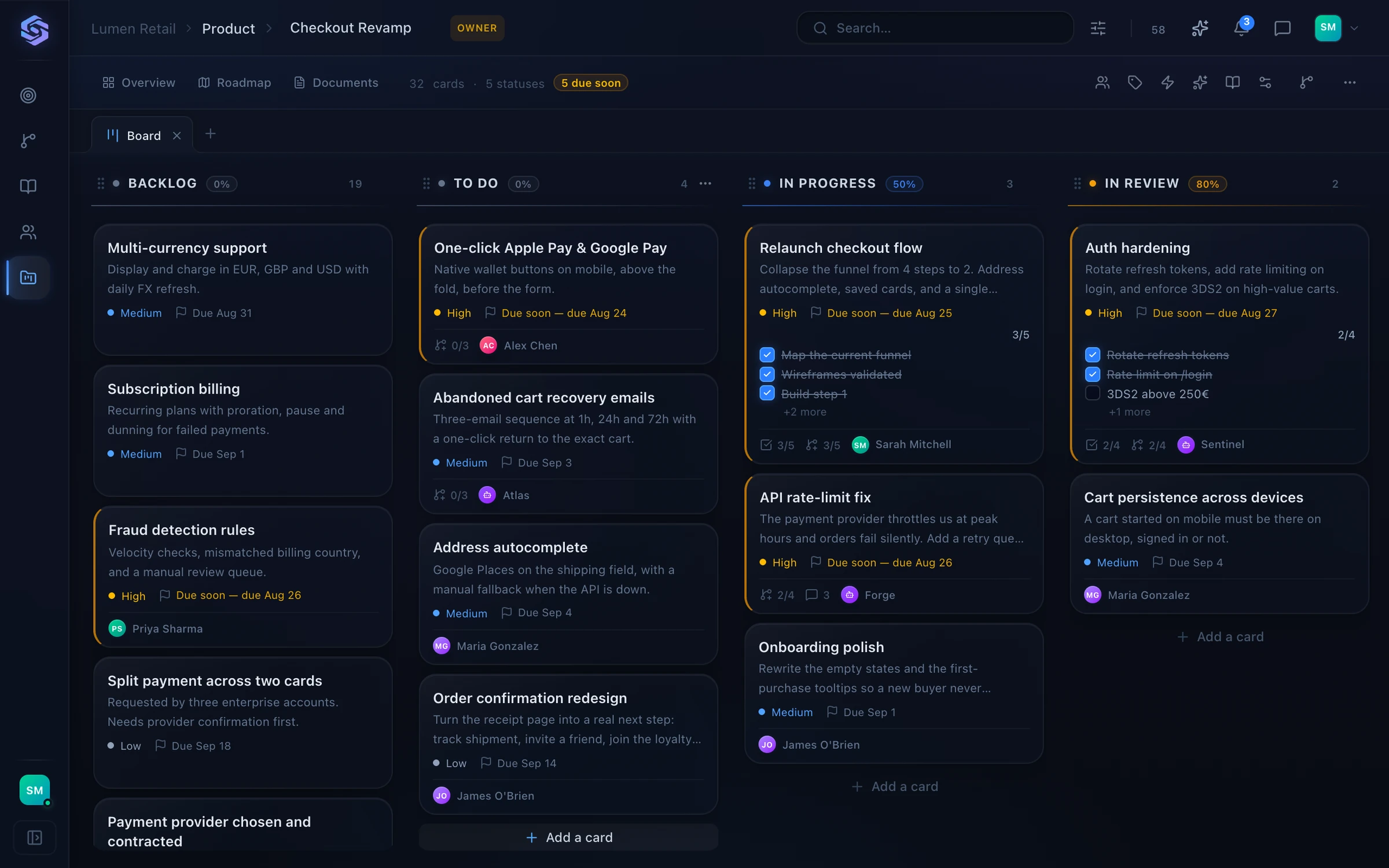 Stellary · See the case study
Stellary, our project-command platform, puts AI agents to work on real projects: missions, perimeters, human validation, and traceability. We do not discover these questions at our clients' — we have already paid for them on our own product.
That is what makes us precise on what AI can do today, and honest on what it still cannot.
How we work
- No AI project without a measurable use case; if AI is not the answer, we say so at scoping.
- Your data stays yours: hosted in Europe, isolated, never used to train third-party models.
- A human validates what commits — send, payment, decision. The machine prepares, it does not sign.
- Costs are measured per use from the prototype: no invoice discovered in production.
- The integration stays independent of the model vendor, which can change without a rebuild.
See the work behind this expertise
Current studio projects showing product, design and development decisions.
What we get asked most
The answers we give anyway at the first conversation.
Does our data train the models?
No. We work with offers whose professional use contractually excludes training on your data, or with open models hosted on infrastructure you control. This is settled in the contract, not on trust.
Is a ChatGPT subscription not enough?
For individual use, often yes. What a subscription does not do: answer from your up-to-date data, act in your tools, apply your rules, and log what was done. That integration work is what turns a chat into a team tool.
How do you handle model errors?
By assuming them. Each use case is evaluated on real cases before production, answers cite sources when possible, and actions that commit go through human validation. A model that is rarely wrong, a circuit that catches the error: that is the combination that holds.
Do you need a large programme to start?
No. The right start is narrow: one use case, one service, a prototype on your data in a few weeks. You widen on proof, not on a plan.
What often comes with it
Apps, business tools, and infrastructure: what keeps an activity running every day.
- Product & softwareCustom softwareCustom software development: management tools, back-offices, and internal business apps, built on your real processes rather than a package.
- Product & softwareWeb applicationsCustom web applications: complex journeys, real time, roles, and data. Reached from a browser, with no install and no store.
- Product & softwareSaaS developmentCustom SaaS development: multi-tenant architecture, subscriptions, roles, and operations. A studio that runs its own SaaS in production.
- Product & softwareInfrastructure & securityDeployment, hosting, CI/CD, authentication, backups, and observability. Put a product in production and keep it safe without slowing its evolution.



An AI use case to scope?
Come with the problem — lost time, the repeated task, the unanswered question. We will see together whether AI is the right answer.
Start a project Reply on business days · contact@anym.fr