
Stellary
The command post for teams that ship with AI agents. You describe a project, the agents move it forward under explicit rules, and a human keeps hold of what matters. Open beta.
- Year
- 2025 — en cours
- Role
- Product, design and development
- Scope
- Product vision · Design system · Backend · Application · AI orchestration
- Stack
- NestJS · Prisma · PostgreSQL · React · Vite · WebSocket · MCP · TipTap
The problem
In most technical organisations, work is scattered. Planning lives in one tool, execution in another, documentation somewhere else again. AI acts without lasting context, and management reads incomplete signals.
Each tool is fine on its own. The cost is the seam between them: copying a ticket, finding the decision that explains a choice, explaining to an assistant a context it will forget at the next session.
Stellary starts from a simple thesis: modern delivery must be managed in a single system, where planning, execution, context, AI action, and supervision share the same objects and the same live state.
The product
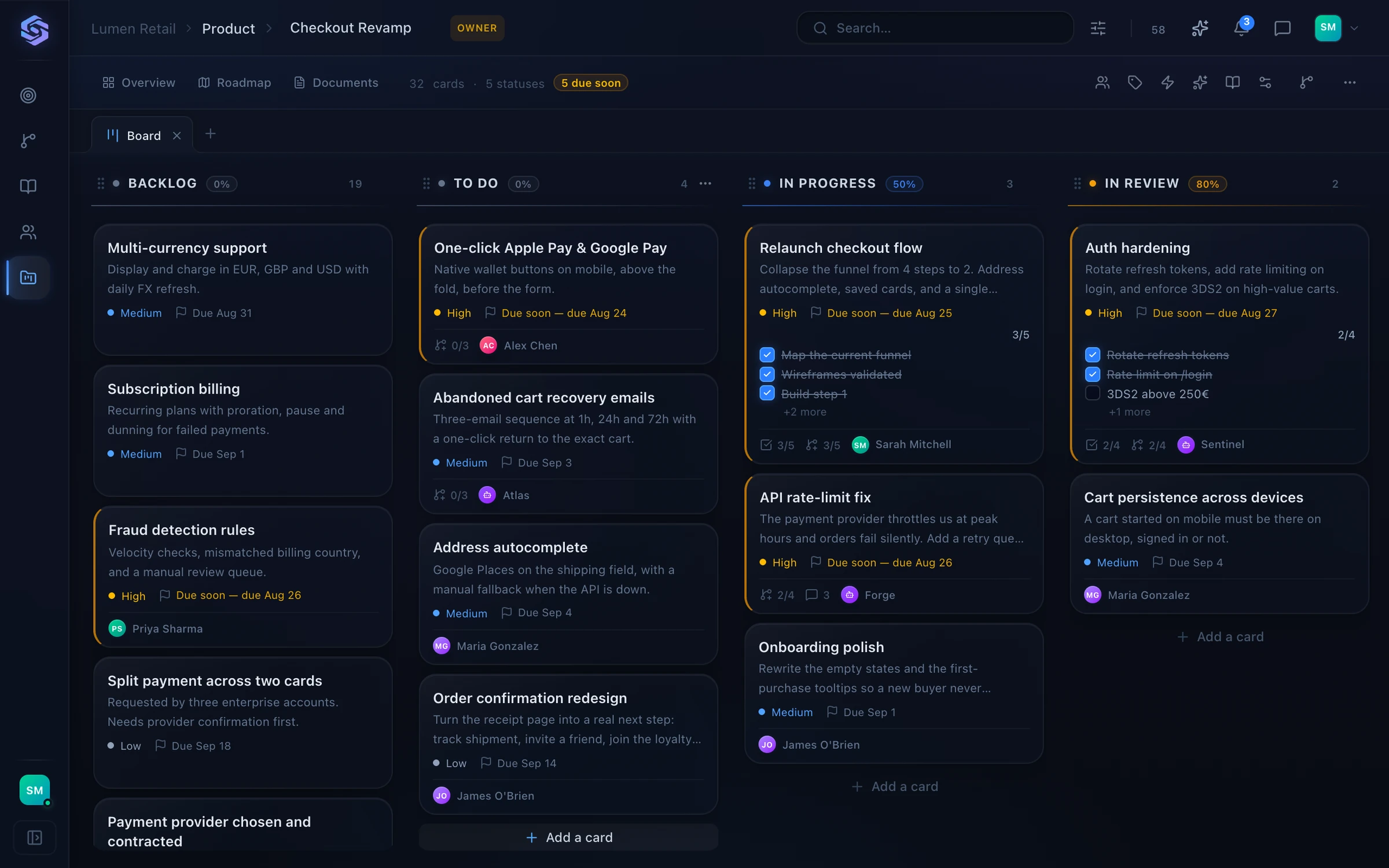
The workspace is the unit of reality: it concentrates members, agents, projects, the knowledge base, plugins, skills, pipelines, and the cockpit. It is not a tracking space, it is a continuous production environment.
On this base, layers articulate. Delivery carries projects, views, cards, subtasks, custom fields, and relations. Context carries documents, knowledge, and templates. Command carries the cockpit, missions, blockers, and briefings.
The layer that changes the nature of the product is the next one: agents, missions, automations, plugins, skills, and pipelines, with MCP access that lets agents manipulate the real objects of the workspace rather than a copy of their description. Software accessed online, usually offered as a subscription. governance covers organisations, permissions, billing, administration, and supervision.
What the product changes
- One state of truth for humans and agents, instead of a context rebuilt at every session.
- Documentary context attached to work objects, so it is available at the moment a decision is taken.
- Traceable AI runs: a mission, a perimeter, a result attached to the project that asked for it.
- A managerial reading that rests on the real state of the system, not on re-entered reporting.
Architecture
The application foundation is a NestJS backend cut by product domains, on Prisma and PostgreSQL, with a WebSocket real-time layer for collaborative view sync. The application is a React and Vite SPA; documentary editing rests on TipTap.
Authentication covers JWT sessions, two-factor authentication, and personal access tokens, needed as soon as agents and external integrations act in a user’s name.
Operations are instrumented from the start — Sentry for errors, Prometheus for metrics — and test coverage combines Vitest on the domain and Playwright on critical journeys. Internationalisation is treated as a design constraint, not a later layer.
Prepare a project of the same order
Decisions to take before scoping, design, or migration.
- Guide logiciel métierExcel, Notion ou application métier : que choisir ?
- Guide intégration IAQue peut réellement automatiser l’IA dans une PME ?
- Guide technologie webWordPress, Wix, Next.js : quel socle pour votre site ?
- Guide technologies webLes meilleures technologies web en 2026
- Guide projet webCahier des charges site internet : un modèle simple
- Guide IA & automatisationChatbot, automatisation, agent IA : que choisir ?
- Guide application métier7 signes qu’une entreprise a besoin d’une application métier
- Guide outils métierCRM, ERP, Notion ou outil sur mesure : que choisir ?
- Guide méthode produitTransformer un processus métier en outil simple